


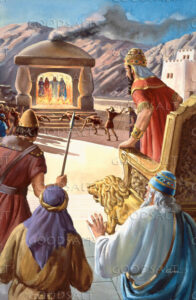
Fourth Man in the Fire: Biblical Meaning and the Daniel in the Lions’ Den Faith Lesson
Fourth Man in the Fire is one of the clearest biblical revelations of God’s presence with His people in the midst of trials. It is not merely symbolic language but a recorded historical and spiritual event found in Daniel 3:24–25, where God manifested Himself in a furnace designed to destroy faithful men. This event, together with the Daniel in the lions’ den faith lesson recorded in Daniel 6:16–23, reveals a divine pattern: God does not always prevent His people from entering trials, but He always preserves those who trust Him.
These accounts show that trials are not always signs of God’s absence. Instead, they often become the very places where His presence is revealed most clearly. The Fourth Man in the Fire represents divine companionship, divine protection, and divine authority over circumstances designed by human hands but governed by divine sovereignty.
Understanding this truth transforms how believers see hardship. Trials are no longer seen as abandonment, but as opportunities for divine revelation.
Fourth Man in the Fire: The Biblical Foundation in Daniel 3
The account of the Fourth Man in the Fire begins in Daniel 3:1–6, when King Nebuchadnezzar built a massive golden image and commanded all people in his kingdom to bow and worship it. The decree was absolute, and the punishment for disobedience was death by a burning fiery furnace.
Shadrach, Meshach, and Abednego refused to bow.
Their refusal was rooted in their loyalty to God and obedience to the commandment found in Exodus 20:3–5, where God said:
“Thou shalt have no other gods before me. Thou shalt not bow down thyself to them.”
Their faith was expressed clearly in Daniel 3:16–18:
“Our God whom we serve is able to deliver us from the burning fiery furnace… But if not, be it known unto thee, O king, that we will not serve thy gods.”
This statement reveals the true nature of biblical faith.
Their obedience did not depend on guaranteed deliverance. Their obedience depended on God’s worthiness.
Faith that depends on favorable outcomes is conditional. Faith that depends on God’s character is unshakable.
Because of their refusal, Nebuchadnezzar commanded the furnace to be heated seven times hotter (Daniel 3:19). The fire became so intense that the soldiers who threw the men into the furnace died from the heat (Daniel 3:22).
The intention was clear: total destruction.
But God had another plan.
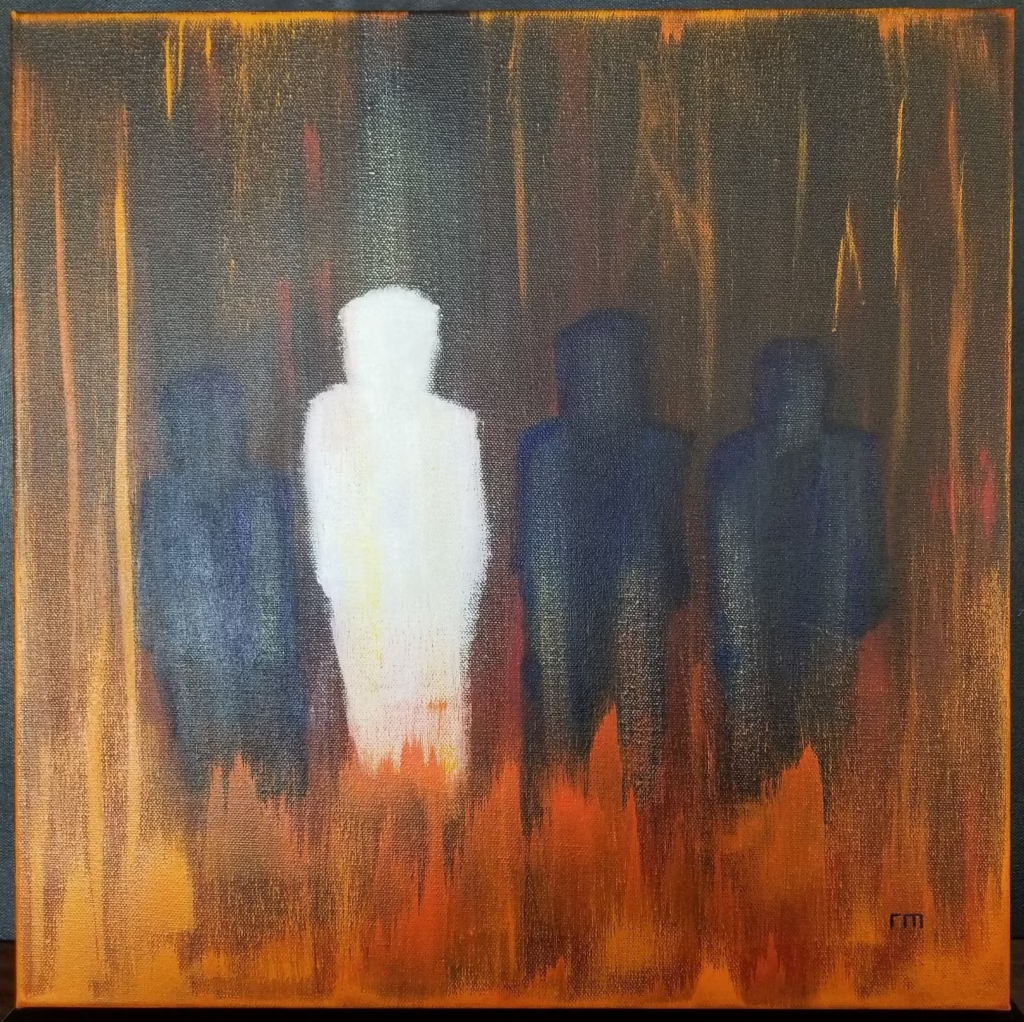
Fourth Man in the Fire: Divine Presence Revealed in the Trial
After the men were thrown into the furnace, Nebuchadnezzar witnessed something that defied human logic.
Daniel 3:24–25 says:
“Did not we cast three men bound into the midst of the fire? … Lo, I see four men loose, walking in the midst of the fire, and they have no hurt; and the form of the fourth is like the Son of God.”
This moment defines the meaning of the Fourth Man in the Fire.
Three men were thrown in.
Four men were seen walking.
They were no longer bound.
They were no longer falling.
They were walking freely.
This reveals that God did not merely protect them from the fire. He joined them in it.
This fulfills the promise found in Isaiah 43:2:
“When thou walkest through the fire, thou shalt not be burned; neither shall the flame kindle upon thee.”
God did not promise the absence of fire.
He promised preservation in the fire.
The Fourth Man in the Fire represents the visible manifestation of God’s invisible faithfulness.
Fourth Man in the Fire: Christ Revealed Before the Incarnation
Many biblical scholars believe the Fourth Man in the Fire was a pre-incarnate appearance of Christ. This belief aligns with the nature of Christ revealed throughout Scripture.
Colossians 1:17 says:
“And he is before all things, and by him all things consist.”
Christ existed before His birth in Bethlehem. He has always been present with His people.
This is further supported by 1 Corinthians 10:4, which states:
“That Rock was Christ.”
Christ was present with Israel even in the Old Testament.
The Fourth Man in the Fire reveals that Christ does not only save from a distance. He enters the situation.
He walks where His people walk.
He stands where His people stand.
He protects from within the trial.
Fourth Man in the Fire: Total Preservation, Not Partial Survival
When Nebuchadnezzar commanded the men to come out, Scripture records something remarkable in Daniel 3:27:
“The fire had no power, nor was an hair of their head singed, neither were their coats changed, nor the smell of fire had passed on them.”
This reveals complete divine preservation.
The fire did not touch their bodies.
The fire did not damage their clothes.
The fire did not leave evidence of its presence.
This demonstrates God’s absolute authority over circumstances.
This fulfills Psalm 91:7:
“A thousand shall fall at thy side, and ten thousand at thy right hand; but it shall not come nigh thee.”
God did not reduce the fire.
He nullified its effect.
Fourth Man in the Fire: When Unbelievers Witness God’s Power
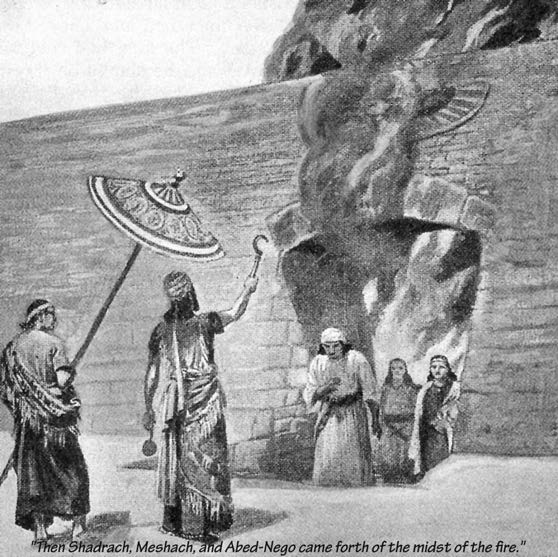
Nebuchadnezzar, who ordered the execution, became the witness of the miracle.
He declared in Daniel 3:29:
“There is no other God that can deliver after this sort.”
The unbelieving king publicly acknowledged God’s power.
This fulfills Matthew 5:16:
“Let your light so shine before men, that they may see your good works, and glorify your Father.”
God allowed the miracle to be witnessed so His glory would be revealed.
Sometimes God allows trials so unbelievers can witness His intervention.
Your trial becomes your testimony.
Your survival becomes evidence of God’s presence.
Daniel in the Lions’ Den Faith Lesson: Faithfulness in Daniel 6
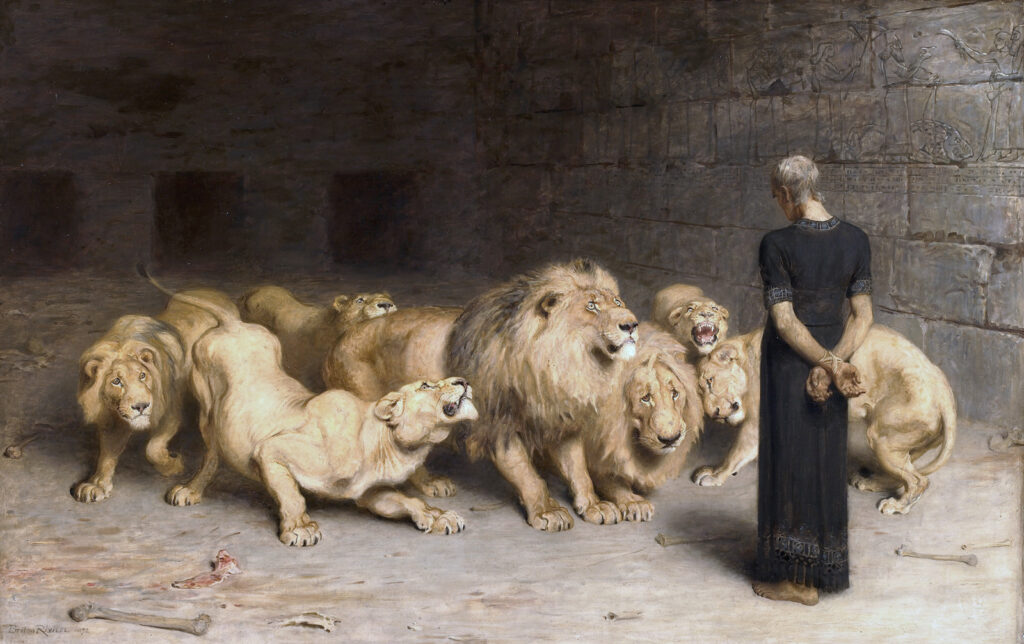
The Daniel in the lions’ den faith lesson reveals another dimension of divine protection.
In Daniel 6:7–10, political leaders manipulated the king into signing a decree forbidding prayer to anyone except the king.
Daniel continued praying.
Daniel 6:10 says:
“He kneeled upon his knees three times a day, and prayed, and gave thanks before his God.”
Daniel did not compromise his relationship with God to preserve his safety.
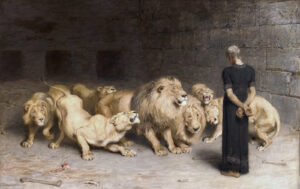
Because of his faithfulness, he was thrown into the lions’ den (Daniel 6:16).
The king expressed hope in Daniel 6:16:
“Thy God whom thou servest continually, he will deliver thee.”
Daniel in the Lions’ Den Faith Lesson: God Sends Divine Protection
Daniel testified in Daniel 6:22:
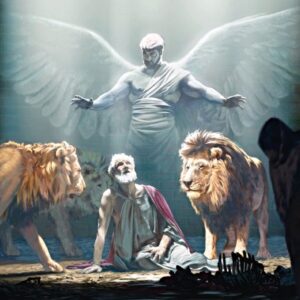
“My God hath sent his angel, and hath shut the lions’ mouths, that they have not hurt me.”
God sent an angel.
God restrained the lions.
God preserved His servant.
This fulfills Psalm 34:7:
“The angel of the Lord encampeth round about them that fear him, and delivereth them.”
God did not remove Daniel from the den.
He neutralized the threat.
This reflects the same principle seen in the Fourth Man in the Fire.
God preserves believers within trials.
Fourth Man in the Fire: Why God Allows Trials
Trials serve a divine purpose.
James 1:2–3 says:
“Count it all joy when ye fall into divers temptations; Knowing this, that the trying of your faith worketh patience.”
Trials strengthen faith.
Trials reveal God’s power.
Trials prepare believers for greater assignments.
This aligns with Romans 5:3–4:
“Tribulation worketh patience; And patience, experience; and experience, hope.”
The Fourth Man in the Fire appears in seasons of testing.
The trial reveals the depth of faith.

Daniel in the Lions’ Den Faith Lesson: Private Deliverance and Personal Revelation
See (How the Lord Used a Box of Plastic Wrap to Show Me His Provision)
Unlike the furnace, Daniel’s miracle was not witnessed publicly during the night.
The angel’s intervention occurred in private.
This teaches that not all miracles are public.
Some are personal.
This aligns with Psalm 91:1:
“He that dwelleth in the secret place of the most High shall abide under the shadow of the Almighty.”
God protects in secret places.
Not all deliverance is performed before spectators.
Some deliverance strengthens personal faith.
Fourth Man in the Fire: Faith Comes Before Manifestation
The three Hebrew men trusted God before seeing Him.
Daniel trusted God before seeing the angel.
This reflects Hebrews 11:1:
“Faith is the substance of things hoped for, the evidence of things not seen.”
Faith precedes manifestation.
God responds to trust.
The Fourth Man in the Fire appears after obedience.
Fourth Man in the Fire: Trials Become Platforms for Promotion
See (Trusting God in Difficult Seasons: When Delays and Trials Are Part of Divine Purpose)
After their deliverance, the men were promoted (Daniel 3:30).
After Daniel’s deliverance, he prospered (Daniel 6:28).
This fulfills 1 Peter 5:10:
“After that ye have suffered a while, make you perfect, stablish, strengthen, settle you.”
Trials prepare believers for elevation.
The fire was not their end.
It was their transition.
Daniel in the Lions’ Den Faith Lesson: God’s Faithfulness Never Changes
God’s protection of Daniel confirms His consistent character.
Hebrews 13:8 says:
“Jesus Christ the same yesterday, and to day, and for ever.”
The same God who protected Daniel protects believers today.
The same God who appeared as the Fourth Man in the Fire remains present.
Fourth Man in the Fire: God Is Present in Every Trial
God promised in Deuteronomy 31:6:
“He will not fail thee, nor forsake thee.”
This promise is demonstrated in both accounts.
God was present in the furnace.
God was present in the lions’ den.
God remains present with believers today.
Conclusion: The Fourth Man in the Fire Still Walks With Believers
The Fourth Man in the Fire reveals that believers are never alone in trials.
The Daniel in the lions’ den faith lesson confirms that God preserves those who trust Him.
These accounts prove that:
God allows trialsuflials
God enters trials
God preserves believers
God reveals His glory
Even in the fire, God is present.
Even in the den, God protects.
Your trial is not evidence of abandonment.
It is evidence of divine involvement.
And when the trial ends, your testimony will reveal that the Fourth Man in the Fire was with you all along.